#8 – Janvier / January 2026
MICHAEL PUNT
A Mon Seul Désir
The Incident in the Bar
« If I smoked, » he said moving up the counter slightly and turning towards her, « I would ask for a light. As it is, all I can say is that I can’t stop looking at you. » Although she realised at once that the man whose reflection she had been idly watching in the mirror for a few minutes was now talking to her all she said (as if she had not heard him) was, « I don’t usually drink coffee, » and seeing that he did not understand that she was being both friendly and distant, she added, « It’s a bit of a ritual. » Since he said nothing she went on, « When I come to Italy, I like to take my breakfast this way even though I usually don’t eat breakfast at home. » She had no idea where this invention had come from and knew the excess of information was beginning to make her sound a little foolish. Turning away to the mirror she saw that she had some sugar and crumbs stuck to the side of her mouth. She brushed them away and embarrassed and flustered averted her gaze. Catching her eye, the barman avoided Italian and asked “désirez-vous?” Later he wondered if it was perhaps because he thought that she looked like a typical Parisian or perhaps it just was one of those mornings when the things we say and the things we mean do not quite come together. She answered the barman in French and then explained in Italian that she was neither French nor Italian and he walked away without answering. As her eyes followed him to the left, she sensed the man also move away from her and, in the mirror, she saw his back become dark and then light as he appeared to walk towards the door and into the street.
That could have been that, but it would have been a long way from the truth. For in the few seconds that she took to answer him he took advantage of the opportunity to look more closely at her face and see the little creases around her eyes that moved as she spoke seeming to underline her thoughts. Later, when he had seen more of her, he would learn to interpret the changing shapes of these fine lines as a secret language so fluently that he could even see when, (like today) what she said and what she meant, was not quite the same, and over time, he learned to read other little signs, that made sound almost unnecessary. But for now, after these first few seconds, all he could see was a shining xx xxx xxxx [1] that he knew already would, like the smells of childhood, never fully leave his memory.
When she first came in he was too busy doing what barman do – moving cups from one place to another and back again with a distracted precision.[2] When he chose to look up and notice her, she asked for coffee in a slightly flirty and old fashioned Italian which he took to mean that she was a tourist and so he replied in French. Other people came and went so that only when a man moved up the counter toward her and start talking did he remember that she was there. At a distance, and in the mirror, he noticed the crumbs on her face and the unusual curve of her mouth and downward glance when she spoke certain words. His eyes were drawn to the grace of her gestures as she said something in Italian that he hardly heard. To assert himself (he did not know why) he asked her from the other end of the bar if she wanted more coffee in an exaggerated Parisian dialect and she replied with perfect mimicry that she was not French then switched languages and said that she was not Italian either. The little laugh she added made him feel uncomfortable and without a word he turned away and studied her face reflected in the chromium plate of the expresso machine. He noticed her turn her head to the door as though contemplating leaving and then took another pastry and put some money on the counter. Later, xxx xxx xx xxxxxx xxxxxx they would each tell a different version of the story of how they met. Spinning the tale out xx xxxx xxx xx xxx xxxx xxxxx wondering how it was possible that xxx xxxxxx xx xxx xxxxxxx xxx xxxx xx they could ever have been the consequence of an accident. But, for now, the barman polished the metal and watched her head turn back away from the door. As if etched into the chromium surface he saw her silver/black image and knew that whatever else, the particular light in the bar at that moment would always be with him.
The idea that this café breakfast was a ritual was a silly invention made up on the spur of the moment. Xx xxx xxxxxxxx xxx xxxx xx xx xxx xxxx xx xxx xxxxxx xxxx xxx xxxxx xxxx xxx xxx. >. Looking in from the street she was enchanted by the bar’s faded ‘modernist’ retro style and drawn by four round paintings that someone had told her (she could not remember who) were called tondos.[3] These were perfectly matched, and in each a detailed landscape was depicted reflecting the ideals of an arcane pantheism. In this context they were quite magical, the more so it seemed when a blank plasma screen flickered into life with the image of an angel fish.[4] At that moment she decided that it would be ‘her bar’ and that whenever she was in Italy she would drink coffee and eat a brioche in such a place before the day really started. She ordered in a slightly old-fashioned Italian manner that she had picked up as a teenager. The barman seemed to be on autopilot relying on muscle memory to move in the confined space between the machines and the sinks with unconscious little sways of his hips avoiding shelves and levers that obstructed the clear way through. She became fascinated at his way of turning cups over silently with an effortless precision while looking elsewhere (anywhere but the cups it seemed to her). For some reason she noticed the shape of his legs, xx xxx xxxxx xxxxxxxx xx xxx xxxxxxx xxx, in the mirror she saw the reflection of his gaze meeting hers. Someone distracted him and he walked away to the other end of the bar without losing contact with her in the shiny surfaces.
When a man approached she was indeed surprised, her attention was quite elsewhere. As a consequence, when he spoke she did not at first hear his words but became aware of two smells that she normally disliked. The smell of milk on his hands reminded her of babies,(a slightly sour, unhealthy odour with a tinge of malice). The second was that of male sweat, xxxxxxxxx xxxx xx xxx xxx xxxxxxxxxx xxx xxx, xx xxxx, xxxxxxxxx xxx xxx xxxxxxxx xx xxxxx xxxxx . On this occasion, however, either because they were mixed or because this was indeed a new adventure, she found both smells (and the barman’s gaze) sufficiently distracting that all she managed to say was to repeat that “It’s a bit of a ritual”.[5] To be more friendly she was going to go on to explain that in fact it was an idea made up on the spur of the moment that exploited one of the great advantages of xxxxxx xxxxx: xxxxx xx xx xxx xx xxxx historical debates about when and where habits formed. But a natural caution held her back for a second and in that fraction the barman called from the other end of the bar “désirez-vous?” and the man became bulkier than she had first noticed, and he left as she had unsuccessfully tried to be witty and pleasant to the barman. At lunch, when she telephoned her sister (for no real reason) and told her of the incident in the bar she said, almost as if by accident, « When the barman spoke to me in French the man sort of turned browner and then left. » She had no idea why she had said that, but it seemed right. Later that night she told her friends the story about a man who came up to her and said, « I would ask for a light. As it is all I can say is I can’t stop looking at you » and then disappeared. She realized (after they had all stopped laughing and joking about him vanishing in a puff of smoke etc.) that the event that had shaped her whole day (and would later affect the rest of her life – and possibly the next one) had taken place in a little more than twenty seconds and resisted any meaningful description. For the rest of her visit, she tried to keep up her ‘ritual’ of breakfast, even returning to the same bar, but nothing happened, and as work intervened more and more, the habit, such as it was, slipped away and not until she returned to Italy over a year later that she remembered (with intention) the incident in the bar.
The Return
When she next visited Italy, she had not been married for very long. It was a working visit and because things between them were not going especially well she had left for her meetings a week early in order to « think things through » she said. Now her thoughts of the incident in the bar were mixed with a bitter present. A year ago she had returned home to her apartment full of the strange mystery of it and had found on the dining room table a book of matches propped up against a vase. They were from the Chapel of the Bells, Las Vagas, and written on the inside in pencil in what she took to be a familiar hand was the simple question, “What about it?” and imagining the incident in the bar to be some sort of life-sign, she rang him immediately and said ‘Yes’. What she could not know, nor ever found out, was that the matchbook was picked out of a vintage collection on a market stall by her long-time lover because he liked the irony of the name and indeed had not even noticed the handwritten message. Nonetheless, in a whirlwind of activity they let her apartment go, summoned all their friends for a wedding to remember, and left for a honeymoon, or at least a holiday (xxxx xxxx xxx xxxx xxxxx xxx xxxx xxx xxxxxx xx xxxx xxxx’x xxxxxx) in Sri Lanka. She looked at the massive Buddhas, tried unsuccessfully to find political groups in cafes, caught strange (and sometimes dangerous) insects, and cried with clenched fists at the poverty and corruption. He hung around the pool in the hotel and disappeared into town from time to time only to return drunk and soulful. Before they were on the plane home she knew it had been a disastrous mistake to marry him and spent the following months trying to work out how to extricate herself from such a calamity. Her few days alone in Italy, xxx xxxxxxx xxxx xxx xxxx xxxxx, was not so much an opportunity to think things through – there was nothing to think through – it was just a way to affect an escape from the strain and unhappiness.
She deliberately looked for a hotel in an unfamiliar district and, in the late evening, set out to find somewhere that she would make “her” bar for breakfast. Retro styling was quite fashionable and she quickly found one that had that familiar faded modernist look that she remembered from the past.[6] The counter was a slab of black marble which was polished to be dramatic without being brash. The Expresso machine was an apparently restored vintage red and gold Gaggia with cups warming on the top which were neither old nor new to give it an established look. Here indeed she thought, where the past met the present so self-consciously, was a place for another dramatic encounter that might rescue her. Excited she returned to her hotel fell asleep at once and, for the first time for months, she did not dream and awoke to the light instantly full of expectation, xxxxxxxx xx xxx xxxx xxxx xxxxx xxx xxxxxxxxxx xxxxx xxxx xxxx xxxxxx xxx xxxxxx xxxx. Not bothering with lipstick she skipped down the stairs, too impatient to wait for the lift which a chambermaid had stalled on the upper floor to smoke a cigarette. At the bar, she took her ‘usual’ and trying not to cast her eyes around for whatever encounter she anticipated, she watched her own reflection holding a brioche and thought of Audrey Hepburn resentfully nibling at a croissant gazing at expensive bracelets and bejewelled chandeliers in the window, and a stressed film crew with a grumpy Truman Capote behind her. And, like Audrey, all she tasted was dry pastry, and all she saw was her own reflection, so she took another coffee and left feeling a little sick and a little saddened. It was a pattern that she repeated for several days before work and reality intervened and, only on her penultimate morning, did she find the energy to return to the bar. She ate and drank distractedly and left, determined that, as soon as she got home, she would find an apartment and just move out. There was no need. In her absence her husband had decided that it was time to go xxx xxx xxxxx xx xxxx xx xxx xxxxxx xxxx – at least that is what the note said. Later she said of her disastrous marriage, “It sort of all worked out with a little less misery than is usual in such cases”.
In the years that followed, the demands of her work seemed to be enough to sustain her. Not that she did not find the time for a variety of romantic adventures. Some were brief xxxxxxxxxxx xxxx xxxxxxxx xxxxx xx xxx others more romantically ambitious but they all petered out sooner or later for two reasons. The first because there was really only one sort of romantic encounter that interested her even though it had lasted for less than twenty seconds. The second was that lovers almost always viewed permission to explore her heart as xxxxxxxxxx xxxx permission to repair broken light switches, upgrade her computer and/or service her car. For some, this was possibly an attractive overture to nesting, but to her, who had won her autonomy at great expense from an oppressive schooling, x xxxxx xx xxxx xxxxx xxx x xxxxxxx xxx xxxxx xxxxxxx, such incursions almost immediately turned the object of her affection into an unbearable habit. xxx xxxxxx xxxxx xxxxxxx xxxx xxxxx xxxxx xxxxxx xx xxx xxxx xx xx xx xxxxx x xxxxxxx xxxx xx xxxxxxxxxxxxx. xxxxxx xxx xxxxx xxxxxx xxxxxxx xxxxxx xxxxxxx xx xxxxxxx xxx xxxxxxxx xx xxx xxxxxxxx xx xxxx xxxxx xxx xxxxx xxxx. Others seemed so inventive and bizarre that she would go through the following days wondering quite what had happened. But she soon found out that xxxxxxx xxxxx xxxxx xxx xxx xxxx xxxx xxx, they too assumed it was permissible to rearrange the furniture or call in a plumber to sort out her bathroom.
Perhaps the most satisfactory love affair that she had xx xxxx. xxx xxxx x xxx xxxx xxxxxx xxxx xxxxxxx, xx xxxx xx xxxx xxxxxxx xxxx xx xxxx xxxxx xx xxxxxxxxx xx x xxx. Xx xxxxxxxxx, xx xxx xx xxxxxxxx xxxxxx xxxxxx xxx xxxx xx xxxx xxxxx x xxxx xx xxxxxxxxxxxx made few demands on her intellectual life, and he was too self-obsessed to offer to repair anything. He spent most of his hours away from her xxxxxxxxnxx xxx xxxxxx xx xx xx xxxd, for a time she looked forward to coming home xxxxx x xxx xxxx xxxxxx. Xxx xxx xxxx xxxx xx xxx xxxxx xxxxxx xxxx xx xxxxx xxx ixxxxxxx xxx and she realised that the rituals xx xxxxxx xxxxxxxxx drained her xxxx xxxx xxx xxxx.
She had xxxxxx xxxx xxx xxxx xxxx xx xxx xxx xxxx xxx friends and xx xxxx xxx xxxxxx, xx xxx xxxxxx xx xxxx xxxxxxx xxxxxxxx xxxx xxx xxxxxx xxxxxxxx, xxx xxx xxxxx xxx, xxx xxx xxx xxxxxxxxx xxxx, when they sat around to swop adventure stories of their most romantic encounters, she had none to tell. They would all shriek at lurid tales xx xxxxx xxxxxxxxxx xx xxx xxxxxx xx x xxxxxxxxx xx x xxxx xxxxx xxxxx, xx xxxxxxxx xxxx xxx xxxxxx xxxx xxxxxxxx xxxxx xxxxx xx xxxxxxxxxx xxx xxxxxxxxx xxxx xx xxx xxxxxxxx xxxxo xx xxxxxxxx xx xxx xxxxxxxxx xx x xxxx xx xxxxxxxx xx x xxx xxxx, but her own ‘most romantic moment’ was literally just a moment and she had discovered over the years that it could not be properly told. It defied language so, instead, she invented humorous stories borrowed from movies and overheard gossip like the rest of them.
As soon as she understood that xxxxxxx xx xxxx xxx xxxx xxxxxxxxx xx xxx xxxx xxxxxx xxxxxxxxx xxx xxxxxx xxx xxxxxxxxx xxxx xxx xxxx xxx xxxx xx he moved back xx xxx xxxx xxxx xxx xxxxxxx xx xxxxxxx xxxx xxxxxxx xxxx xxxx xxx xxxxxx xxxxxxxxxx. Perhaps if she had been able to share the ‘incident in the bar’ then she need not have wasted so much time before understanding what had happened in that encounter. As it was, the time passed by, and three years after she had left her husband, she moved to another country and a few years after that she lost her wedding ring, which she had always found useful in fending off amorous co-workers and well-meaning matchmakers. She took it off to wash and it bounced into the bidet in a hotel bathroom. She faintly hoped that it might have been flushed into the sea and eaten by a fish to make a good story. Perhaps someone would discover it in a pie, after all such coincidences do happen. Indeed they do xxx xx xxxx xxxxx, xxxxxx xxx xxxx xxxxxxxxxxxx xxxxxxxxxxxxx xxxxx xx xxx xxxx, by some extraordinary coincidence she was offered a job in the very city in which she had, what she now called to herself, ‘my xxxxxxxxxx incident in a bar.’
The Move
Her move to another city was unexpected and a welcome disruption to her life. So anxious was she to start afresh by returning to the site of her extraordinary encounter that she agreed to take up her post and move before finding an apartment. She chose a hotel in the same street as the bar and, after staying there a few days, negotiated a room on the first floor from which, with effort, she could see the very door he had left by. And so, for many evenings she sat rather awkwardly by the window working and watching who came and went, how long they stayed, and who they left with. She was amazed at the predictability of an apparently casual trade. She was equally amazed at how many assignations that began in the bar continued there the following morning with the same breakfast that she now took daily. Standing at the counter looking in the mirrors, or the reflections in the chromium plating, she imagined her own assignation while noting those that developed around her. During the months that followed (for she chose to stay in two rooms in the hotel and let the flat to another company exile) she saw the predictability of the human heart, its brief delirious excitation, and its rapid return to stability and a regular pulse. It both amazed and saddened her, as at the same time, she also recognised its contrast to the enduring beauty of her own heart which jumped each morning as she awoke and remembered where she had fallen asleep.
Later, she discovered by accident, that there was thought to be a rational reason why her heart skipped each morning.[7] But she knew different. Intermingled with the smell of diesel fumes, cigarette smoke and tar, the distinct bitterness of coffee and the slightly unhealthy malodour of steamed milk gently called up her past. It was through her senses that she was connected with the object of her romantic focus before she was fully awake and, in the few minutes she allowed herself to lie there listening to the clicking heels, the trams and the cars, she thought that she could taste the sweetness of the sugars that were dusted on the cakes and the distinctive stickiness of the cherry jam.[8] And if it had rained during the night, dampening the dust or washing the streets, she could also feel the urgency of the super-hot water as it was forced through the coffee grounds in the portafilter. As she became more sensitive and discriminating she noticed other smells that seemed to emanate from the bar, some she could not quite account for and others she thought might be human. The aromatic landscape was most dramatic if some over-perfumed man or woman passed under her window and corrupted the delicate cocktail from the bar with an assault of musk and alcohol. For an hour it would hang there weakly, and yet despite its eclipsing desires, the enduring aromas of her passion still persisted and, over time, would become clearer and dominant once again. She took to avoiding all perfumed toiletries ridding her bathroom of synthetic aphrodisiacs. If she felt the need for some fragrance about her she would sometimes carry a small package of freshly ground beans and in her bag.[9] At night, when the Gelatieri on the corner opened and all the courting couples, (together with their mothers and fathers) would stand outside gossiping the bars distinctive smell would mix with the combined perfumes of the cigarettes and ice creams to become an erotic sensation of babel and scent that cloaked the neighbourhood. And later when first the bar and then the Gelatieri closed, and the evening cooled, the sounds and aromas lulled her, and before they finally dissipated into the night-air she would invariably be snoring a little as she fell asleep tasting the fullness of the day.
Gradually, and without deliberate intention, her visits to the cafe did become the ‘bit of a ritual’ that she had fabricated many years before. Much later she would remember that throughout her whole of her stay at the hotel, and even after she found an apartment in the same street, she never once replied to the barman’s “désirez-vous?” except with a smile. Every day he met the smile with coffee in a white cup with a small red logo, then snaked his way back to the machine to fetch some warm milk, and finally, without looking down, he retrieved a glass from beneath the counter and filled it with water from a fresh bottle. He placed a spoon on the edge of the saucer in a particular way so that the bowl did not touch a surface, and, after the first day, always pushed the sugar up the counter away from her. She began to notice that in the bar she felt more at home with herself than at any time in her life. She felt alive and xxxxxxxx xxxxxxxxx, xxx xx xxx absently remarked to her sister, xx xxxxxxxxx xxx. “x xxxxxxx xxxxxx xxx xxxx xx xxxx xxxx xxxx xxxx xxx xxxxxx sxxxx, xxx here I am in a deeply meaningful relationship with a coffee shop!” They laughed but afterwards she wondered why she had even said it, but by this time it was possibly true since she had moved into an apartment with a balcony and terrace garden that directly overlooked her breakfast bar. And even though she now had her own kitchen, she took her morning coffee there and sometimes, if she was working at home, would drop by in the afternoon to break the day.
As winter came and the smells changed she began taking a book to breakfast. She had bought it long ago because someone, she could not remember who, had said she might enjoy it. And indeed, she did although she only read it fitfully on trains and hardly followed the story, preferring just to ‘hear’ the voice of the author and sentiments from another culture. Once she noticed that the barman looked at the cover as he poured the water. In his business it was usual to be able read texts upside-down, so there was no need for him to turn it, but he did, just a matter of ten or fifteen degrees, and then returned it to its original orientation without saying anything. She would reread passages only when it was quiet in the bar since she much preferred to invent her own stories around the loves and losses of the passing trade. She enjoyed trying to guess how long it would be before they stopped meeting this one person, how miserable (or happy) they would look when that person stopped coming, how soon they would bring another person and so forth. But she kept the book with her as a sort of talisman, as an attractor for her own assignation (who by the way, “was taking his time to turn up,” she sometimes crossly remarked to herself), and who in fairness, she conceded, she had forgotten for quite long periods. So, with Spring, the light changed, and her heart was lifted even more by the tender green of the leaves and the new hopes of the people around her. Her work was going well, and she somehow had acquired a network of wonderful friends. Those, she invited to visit her new apartment, she took one by one to drink coffee in her favourite place, never sharing why it was so special to her. And yet each came away and said how lucky she was to be so close to such a bar and she felt good except that somewhere on her travels in the last two or three months she had mislaid the book xx xxxx that she felt may have given wings to the extraordinary connection that she waited for with her coffee every day.
The Call
She was woken by the sound of her telephone at around 4.30 am. A little confused she answered and heard a man’s voice talking in English with the suggestion of an American accent. She imagined him to be shortish, rather overweigh and round, balding and sun tanned. He certainly had a charm and the rhythm of his speech and the variations in the cadences suggested a lively mind and quick wit. She made this assessment as she slowly drew herself awake, and when he stopped speaking, and she heard the silence she realised that he must have asked her a question. By now, quite used to her own fallibility when people unexpectedly spoke to her, she replied with absolute candour and the man had to repeat himself. In effect she was being invited to visit the office in California to talk about working there. He graciously repeated that she should visit and look at the place, and if she liked it she should think about moving. Too late to go back to sleep ( xxx xx xxxxxxx xx xx xxxx xx xxxxx) she lay there hearing the day start below: the street cleaning machine that sounded so much larger than it actually was, left an apocalyptic stillness behind its’ chaos, and then, first a scooter then a car and then a stream of cars passed under the window, and then a short silence again before the sounds of shops and bars coming to life, and then that moment: Two sliding surface bolts, as the doors opened across the street; one up, one down grating against the springs to slip out of their keeps and settle for the day out of harm’s way. She strained her ears to catch the familiar sound of crockery and the first hiss of steam as the machine was cleaned. A fear overcame her excitement as she wondered for a moment if she could leave these sounds and smells. Then the very idea that for one moment she might equivocate on account of a fantasy frightened her even more, and she seriously wondered if what had started as a game had become an unhealthy obsession. Of course, she would go to Santa Cruz and talk seriously about spending time in the USA. And she did.
It became a special day. She visited her breakfast bar, did her work, prepared herself for a meeting and, for recreation, walked in the market sensing the exotic history of the sea as she passed the fishmonger’s stalls and the harsh collisions of the metal pails on stone as ice was brought up and dumped on the slabs. She held limes and lemons as though they were exotic jewels whose tantalizing colour was resting somewhere below the surface.
A few days later she was at the airport, far too early, listening to the gossip and waiting for her flight to be called. In the lounge and old man with a bronzed and wrinkled face was talking to his friend in that inclusive way that men, who used to be noticed, develop as soon as they retire. In a theatrical accent he shouted that he was going home, going home to California, and before he was asked by immigration where he was headed, he said “Paradise, I live in Paradise!” He laughed to tell everyone the joke was over and watching him she was not sure if that was her destination as well, if she was about to leave her cultivated routines and stories for a theatrical affair in Paradise.
Xxxxxxxx [10]
She was right almost to the centimetre. The man who met her in San Francisco was brown and healthy looking with lively eyes and a huge stomach which was, as she soon learned dining with him, the consequence of a complete lack of will power when he was near any sort of food (good or bad). He was exactly the height she had guessed from his voice and the lyrical rhythms of his speech pattern, and his unstudied fluency beguiled her so that all the way from the airport across the mountain and back down to the sea she did not absorb much of what he said but managed somehow to keep him talking and convince him she was intelligent. He spoke of emerging industries and new kinds of consumers, lifestyle changes and heightened expectations. She responded with charm and wit which masked her discomfort with what he was saying and, while he knew at once she was the person for the job, she knew equally quickly that she was not. By the time they reached the hotel it was dark and she looked for her room with a certain conviction that, coffee bars of the past and charming brown strangers of the present apart, this was not the place where fate should take her. And yet the moment she found her door (and worked out how to open it) she felt a rush of pleasure and was at once intoxicated by the wind and the noise of the sea rushing in through opened windows. For some time, she simply stood on the balcony less than twenty yards away from the waves engulfed in darkness. She listened with the particular intensity she saved for early mornings as though waiting for some sign of a new life amidst the catastrophe of an earthquake. And she heard it, at first wondering if she had made it up from a movie, but when it sounded again she knew it was a real train probably half a dozen miles away whistling at a crossing and she stood there trembling as it got closer whistling all the while – defining a vast space with a single note until nearby she heard the wheels grind on a curve like a knife being drawn across a stone, and then the whistling carried on through the night until she could hear it no more, no matter how hard she strained. At last, in the bathroom, xxxxxx xxx xxxx xxxxxxxxx, she looked at her reflection and saw in her eyes that she had wept, xxxx xxxx xxxx xxx xxx xxx x xxxx xxxx, xxx xx xxxx xxxx.
She slept with the windows open, and despite the turbulence and the noise of boisterous nature, she slept like a child to be woken at dawn by the barking of sea lions as they quarrelled over the best positions under the pier. This was indeed Paradise at last. Dressed in just a bath robe she walked the short distance across the sands to the sea and swam out toward the barking until she came close to a pod of thirty or forty sea lions clustered in a circle sliding over and under each other. Heedless (or possibly unaware) of the danger, she floated closer until she could hear their breaths, and even the occasional soft rasping as one body slipped over another. Entranced, she floated until she could touch one of the creatures and she felt the rough skin under her hand and was instantly reminded xx xx xxxxx xx xx xxxx xxx’x xxxx xxxx xxx xxxxxxxx xxx xxx xx xxxx xxxxxxxx xxxxxx xx xxxxxx xxx xxx and became frightened. So, she drifted away from the slapping of flippers and the grunts of pleasure that these animals seemed to exchange in order to stay together. In this most beautiful place she had survived an adventure perhaps more dangerous than she realised and knew for certain that she should not come to work and live in Paradise.[11] Its recklessness taught her that she no longer needed a man to accost her in a bar with a the words « If I smoked, …”: After the storm of sea and the haunting sounds of the freight train she understood that these words lacked the poetry that she sought.
She stayed in Paradise for a month, partly working and, whenever possible, enjoying her new autonomy. She drove along the coast and saw the blonde sands of Carmel, was waited on in the humblest of cafes by the handsomest of men and women, (all waiting to be discovered by some Hollywood talent scout). She stood on various unbelievably cinematic view-points gazing at the sunset over the Pacific Ocean wondering if she might find relief from the synthetic with the sound of the cherry blossom in Japan as it burst in a tidal wave of colour painting the islands from south to north. She felt the sun on her shoulders as she ate grits and hash browns (only once) for breakfast, and touched the hairs on a man’s arm because they were so golden, and she thought he would not get the wrong idea. He did, scratching his ear and growling like an angry lion when she refused to go to a bar with him. Paradise, she decided was exactly all it was cracked up to be – an idyll for those who had given up on themselves. And when it was time to leave, when she had graciously refused the job offer and would have expected to be excited about returning to her city, her apartment, and her breakfast ritual, she discovered herself to be strangely placeless. Something about this Paradise had changed her and she felt footloose and even alien in her own body much as she had done in her teenage years, only this time around she felt very happy about it.
On the return journey the airport lost its liminality, no longer did it feel like a space between spaces. It felt no different to the apartment, the bar, or her hotel room. It was just a place like any other in which she, or more precisely her presence, was the specialness that made it hers. In the sudden transformations that had overtaken her in the sea, she began to understand the world quite differently. What she had discovered in Paradise was that asserting dominion over her senses did not fragment the world but, paradoxically made it an infinitely fuller multidimensional domain in which all things that she could – and would – ever think, could – and – would be possible. With this discovery she felt so weightless and energised that she could have flown at the speed of light by herself, interrupting the reality somewhere else appearing, in an instant, like a returning angel. But as it was, she travelled club class sitting next to a very sweaty (and apparently famous) fat man who spilled over into her seat and snored. It mattered less to her now as she felt each movement of the aircraft; its uncontrolled yawing and slipping and the purposeful changes in altitude to avoid turbulence. Every sensation mattered now as she experienced the world as her place rather than one that was made before her arrival by people with whom she had little in common. Not to say that she had ceased to love and enjoy the fallible human-real around her, but she found herself feeling both continuous and discontinuous with everything that had formerly appeared fragmented and in its place.
Of course, the plane touched down, stopped its engines and opened its doors without incident. She did file out behind the unsteady fat man who seemed to have to shake the hands of all the cabin crew and held everyone up to excessively thank the pilot who really wanted to finish the landing checks and go home. She did pass through immigration and customs and into a taxi as normal. And she did put the latchkey in the lock and open the door unceremoniously to the space she loved the most. But this time there was no hierarchy in her senses; it was like sailing in a small boat, she thought, when the vessel, and the wind and the water are an inextinguishable lifeforce in constant negotiation over infinitely small factors, so finely divided that no single agent could claim determining power for the consequences. She unpacked her luggage, and indeed separated her laundry into piles, – hand-wash, coloured and whites. She conformed to other useful divisions, sorting the mail: junk, business, personal; she ate in the kitchen, sat on the balcony and slept in the bedroom. But when she looked across the street and saw the bar, she no longer thought of her encounter there all those years ago as something that happened in twenty seconds. Instead, she realised that it had never stopped happening from the minute she had heard the sound of the voice.
The Bar
She did not rush to the bar the very next day, as in earlier times she might have expected herself to, but took her time to order the ordinary in her apartment. When eventually she did go, she had done her laundry, read her mail, paid all that was demanded, replied to all those friends who needed and answer and dumped the rest. Somehow all that, and living too, had taken days and her return was almost like the first visit – opportunist, casual even a little diffident. It was late afternoon, and she had been visiting the market buying bits of this and that, enjoying the sights and smell and sounds of it all and relishing her own transactions with people who seemed to care about what they were selling. As she entered, she felt as though she was meeting an old boyfriend from her teens, someone with whom she had shared the first fumbling excitement of being a grown up. Now she felt properly grown up – almost a little sheepish at her own compulsive morning ritual and the obsessive delusion that had driven it. He smiled as she entered and asked “désirez-vous?” at which she shook her head feigning disbelief that he should remember.
He had noticed her absence (in Paradise) and her return and activity in her apartment, and was (uncharacteristically) a little put out that she had not come sooner, but also (uncharacteristically) so pleased to see her making her way across the street that, before she arrived, her saucer was there on the marble with the water, and the spoon waiting for the coffee – a monochrome essay in black and white with a silver highlight. She smiled her thanks and stood at the counter looking at her reflection in the mirrors and in the chromium plating, (even in the back of the upturned spoon). It gave it all a faintly ecclesiastical air. As though in an exotic Baroque cathedral, the décor seemed to insist that there was an existential danger in allowing the eye to rest for too long on any one thing. Now as she tasted the water, she was reminded of eating snow; its slightly gritty taste was mixed with a purity that was underlined by the after-taste of the coldness. This was the water that he had served her for years but today, it was not just some fluid to cut the bitterness of the coffee, it had, she said aloud lifting the glass slightly, “the flavour of fate.” She had no idea how the phrase came to her, but today it did not sound like nonsense.
And then she heard what she had never included in her story of the incident in the bar. She heard him clear his throat. Why else would he talk of smoking if he had not previously smoked? If he had not asked other people for a light as a way of getting to know them? If he had not opened many flirtations with the offer of a cigarette? It was the little cough of a reformed smoker. The scar of an addiction broken that stays with the smoker forever: A slightly increased sensitivity to the air and its impurity woven together with the repressed longing to pollute it just one more time; a fascination with pointless risks and nicotine clouds that carry the smallest particles of carbon. He cleared his throat the way that he did the first time and before he could utter the words, “If I smoked…“ she turned to face him, this time to hear and answer. But there was no one, and glad that she had not been overheard talking of fate she dropped her gaze to the saucer and the image in the upturned spoon to hide her embarrassment and disappointment, yet as she did she saw the barman looking up the counter at her.
He cleared his throat again, « xx X xxxxxx,” xx xxxx xxxxxx xx xxx xxxxxxx xxxxxxxx xxxx xxxxxx xxxxxxx xxx, “X xxxxx xxx xxx x xxxxx. Xx xx xx xxx x xxx xxx xx X xxx’x xxxx xxxxxx xx xxx » This time instead of turning she looked ahead and saw him – saw for the first time his dark hair, his round eyes, and gentle smile. She saw in those eyes and that smile the devotion and patience of another age, one long since forgotten except by the most esoteric of scholars, one in which the manner of love was inseparable from the act of love. She touched his arm the way people touch the very ill. As if to communicate beyond the corporeal, because as before, she could say nothing as a cascade of memories and ideas engulfed her. She looked at him now for the first time seeing not a man who had served her coffee, but one who had inexplicably never taken a day off in case he would miss her. One who, maybe less than ten times in all the years, had touched her hand in the course of his work. One who had watched her from every reflected surface in the bar and, only when he was sure that she would not see, look at the crown of her head as she bent over a newspaper or novel. One who had been surprised at his own emotion when he saw there, the first single grey hair. One who had learnt to interpret the changing shapes of the minute creases around her eyes as a secret language of her desire. She saw the man who had strained his ears for the faintest of sounds to unpick her from the cacophony of the city. The man who knew all the best places in the bar from which to catch her footsteps on the street, and who later, when she took an apartment across the way would listen in the quieter afternoons, to her typing, closing doors, running baths and the sounds of the other routines of being. Here indeed was an incredible creature who would recognise the scent of her hair before she came in, who could see her mood from the coffee beans she chose to carry, whose own smell of sour milk and maleness he had tempered by placing a bowl of lemons on the bar where she sat. A creature who had reserved a special mineral water for her alone of all his customers, a mineral water that from the day she entered his bar he drank to the exception of all else. One who had reserved a spoon that he kept by the bottle under the counter that was never used by anyone but the two of them. Here was a man who after the first few seconds of casting his eyes upon her knew already that she would never leave his memory, and his duty was to ensure that he served her invisibly for a lifetime.
She saw him for the first time and understood the purpose of her trip to Paradise where surrounded by the synthetic she had found her own sensibility as the only reliable entry into the world. Had found catharsis in the whistle of a train and the crash of waves and the bark of sea lions. Had learned to renounce the trivial satisfactions of half understood desires. Had discovered that in order to hear, see, taste and touch beauty, one simply had to be beautiful. Not the fugitive beauty of innocence, so valued at the bourse of marriage; not for her the virgin’s glimpse of the mythical unicorn xxxxxx xxx xxxxxx xx xxxxxx xx xxx xxxxx xxx xxxxxxxxx. But the beauty of a single desire, so perfect, so precise, so complete as to be placeless, dimensionless, timeless. To acquire that sort of beauty takes time, and, in Paradise she had learned what beauty was, and now she saw him. Saw him for the first time in its fullness.
He cleared his throat again with that reformed smokers cough and repeated his declaration, « Xx X xxxxxx, X xxxxx xxx xxx x xxxxx. Xx xx xx xxx X xxx xxx xxX xxx’x xxxx xxxxxxx xx xxx. » And although she had told the story to herself and others a thousand times, and had had many years to think of what she might reply, it had never occurred to her to even try to respond. In all the hours that she had spent dreaming of a future passion, she never imagined what she would have to have said for the story to develop. She had daydreamed the story of their encounter in all its detail but overlooked the smallest and most difficult step to take – the necessary shift from one reality to the other. As a consequence, she was as much at a loss this time as when she had first heard him. Troubled by this loss she recognised a slight animal yellow in his pupils and noticed that the softness of his mouth evoked the kindest of horses; and suddenly she saw him as the eternal creature that, in earlier times had been woven into history as the companion that held the curtain aside to allow his mistress to enter the eternal.
Today she knew enough to ask a question and, with her eyes driving in to his, she said, rather theatrically, “So since you no longer smoke and I cannot offer you fire, I can at least ask how long you would keep your eyes on me if I decided to let you?”. And fearing that because what he had to say was important and (as usual) she would not hear it, he bent down xxxxxxx xxxxxx xxx xxxx xxx xxx and reached below the counter to where he had kept the exclusive mineral water that he had served her with for half a lifetime. He lifted the book that she had lost – the book that someone, she could not remember who, had told her to read because it was about love – and placed it on the marble. He turned to the very last page and running his finger along the final sentences said,
“That long”. [12]
She knew the passage well, but followed his finger with her eyes moving her lips slightly to let him know that she was reading as he was pointing, and answered,
“I guess that’s long enough – at least for now”.
The bar was empty, and she turned away from him for a moment and walked towards the door. She released the blue blind that she had listened to, in the quiet of her room, being raised and lowered a hundred times, and pushed the door to so that she could drive the squeaking surface bolts – one up and one down – into their keeps. She turned to see him in the semi-darkness and, (perhaps it should be no surprise), she saw no one. There was no man, no bar, no coffee cups or Expresso machine: Nothing but pure light.[13]
——————————
[1] There are a number of redactions in this text to avoid assumptions where necessary sentiments in the protagonist are inevitably inaccessible to the author but are necessary if the character is not to be deprived of her depth and dominion.
[2] There are a number of redactions in this text to avoid assumptions where necessary sentiments in the protagonist are inevitably inaccessible to the author but are necessary if the character is not to be deprived of her depth and dominion.
[3] Although barista rather than barman might seem to be the better term for him, in its current English usage ‘barista’ diminishes the necessary interpersonal and performative skills that distinguished him from the scripted operators in corporate global coffee chains. I have chosen to call him a barman even though technically in city cafes the term is reserved for the person responsible the technical aspects of mixing drinks.
[4] In fact these were English paintings and, since these were quite small, they would not normally be called tondos.
[5] The fish was a Centropyge interruptus.
[6] In the last few decades, many scientific studies have been conducted to investigate the effect of inhalation of aroma on human brain functions. The studies have suggested a significant role for olfactory stimulation in the alteration of cognition, mood, and social behavior. See: Sowndhararajan K, Kim S. Influence of Fragrances on Human Psychophysiological Activity: With Special Reference to Human Electroencephalographic Response. Sci Pharm. 2016 Nov 29;84(4):724–751.
[7] It was not difficult to find an almost identical bar. Although bars were largely independent enterprises at the time there was a fairly well established style for designers which, by and large, was determined by the dramatic appeal of retro expresso machines.
[8] Hawiset T. Effect of one time coffee fragrance inhalation on working memory, mood, and salivary cortisol level in healthy young volunteers: a randomized placebo controlled trial. Integr Med Res. 2019 Dec;8(4):273–278. doi: 10.1016/j.imr.2019.11.007. Epub 2019 Nov 14. PMID: 31799117; PMCID: PMC6881620.
[9] It was mainly confettura di ciliegie.
[10] At the time perfumiers had not developed coffee fragrances but had they been available, as they are today, almost certainly they would not have met her expectations.
[11] The subheading of this section ‘Paradise’ is redacted here to avoid confusion with the reader’s conception of the term. For her, it is a very specific realm in which she exists in the intangible beauty of her autonomy.
[12] This was indeed a very risky and somewhat foolish adventure especially as she was unaware that sea lions can attack humans unless they keep a few meters away. However, there is a validated report that Californian sea lions are less aggressive and one actually kept a downing person afloat until they were rescued.
[13] “And then he told her. Told her that it was as before, that he still loved her, he could never stop loving her, that he’d love her until death.” Duras, Marguerite (1984). The Lover. Translated by Barbara Bray. Fontana, London. pp.123.
References:
This fiction was inspired by finding a prop from a 16mm film that I made in 1989 (now lost) in which a single red thread (weft) of the tapestry was very gently pulled from left to right. (See image, note 14).
Chodorow, Nancy (1995) « Becoming a feminist foremother ». In Phyllis Chesler; Esther D. Rothblum; Ellen Cole (eds.). Feminist foremothers in women’s studies, psychology, and mental health. Haworth Press. pp. 141–154
Duras, Marguerite (1984) The Lover. Translated by Barbara Bray. Fontana, London.
Pansini, Stephanie Rianne (2020) The Unicorn Tapestries: Religion, Mythology, and Sexuality in Late Medieval Europe. Master’s thesis, Harvard University Division of Continuing Education.
Sand, George (1923) Jeanne. Reprinted by Nabu Press (2010) (The publisher notes that “This is a reproduction of a book published before 1923. This book may have occasional imperfections such as missing or blurred pages, poor pictures, errant marks, etc. that were either part of the original artifact, or were introduced by the scanning process.’)
Williams, Shelley, (2009) Text and Tapestry: The Lady and the Unicorn, » Christine de Pizan and the le Vistes. BYU Scholars Archive. Dissertations. Paper 1721.
Zweig, Stephan (2013) Letter from and Unknown Woman and Other stories. Steerforth Press.
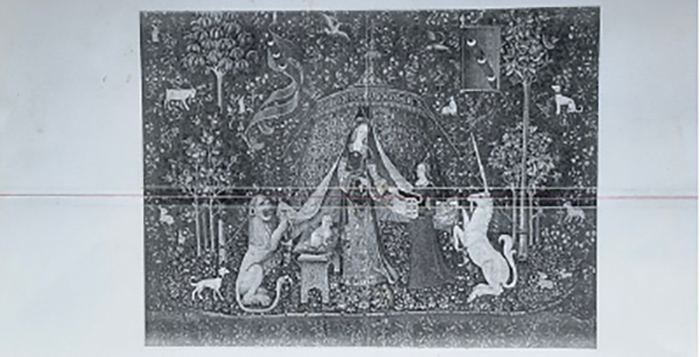
An unadulterated image of the series and others can be found at: https://www.musee-moyenage.fr/en/collection/the-lady-and-the-unicorn.html
